6DAS | pdb_00006das

Discovery of Potent 2-Aryl-6,7-Dihydro-5HPyrrolo[ 1,2-a]imidazoles as WDR5 WIN-site Inhibitors Using Fragment-Based Methods and Structure-Based Design


Experimental Data Snapshot

  • Method: X-RAY DIFFRACTION
  • Resolution: 1.80 Å
  • R-Value Free: 
    0.222 (Depositor), 0.220 (DCC) 
  • R-Value Work: 
    0.177 (Depositor), 0.178 (DCC) 
  • R-Value Observed: 
    0.179 (Depositor) 

Starting Model: experimental
View more details

wwPDB Validation 3D Report Full Report

Validation slider image for 6DAS

Ligand Structure Quality Assessment 


This is version 1.2 of the entry. See complete history

Literature

Discovery of Potent 2-Aryl-6,7-dihydro-5 H-pyrrolo[1,2- a]imidazoles as WDR5-WIN-Site Inhibitors Using Fragment-Based Methods and Structure-Based Design.

Wang, F.Jeon, K.O.Salovich, J.M.Macdonald, J.D.Alvarado, J.Gogliotti, R.D.Phan, J.Olejniczak, E.T.Sun, Q.Wang, S.Camper, D.Yuh, J.P.Shaw, J.G.Sai, J.Rossanese, O.W.Tansey, W.P.Stauffer, S.R.Fesik, S.W.

(2018) J Med Chem 61: 5623-5642

  • DOI: https://doi.org/10.1021/acs.jmedchem.8b00375
  • Primary Citation Related Structures: 
    6D9X, 6DAI, 6DAK, 6DAR, 6DAS

  • PubMed Abstract: 

    WDR5 is a chromatin-regulatory scaffold protein overexpressed in various cancers and a potential epigenetic drug target for the treatment of mixed-lineage leukemia. Here, we describe the discovery of potent and selective WDR5-WIN-site inhibitors using fragment-based methods and structure-based design. NMR-based screening of a large fragment library identified several chemically distinct hit series that bind to the WIN site within WDR5. Members of a 6,7-dihydro-5 H-pyrrolo[1,2- a]imidazole fragment class were expanded using a structure-based design approach to arrive at lead compounds with dissociation constants <10 nM and micromolar cellular activity against an AML-leukemia cell line. These compounds represent starting points for the discovery of clinically useful WDR5 inhibitors for the treatment of cancer.


Macromolecule Content 

  • Total Structure Weight: 69.56 kDa 
  • Atom Count: 5,430 
  • Modeled Residue Count: 609 
  • Deposited Residue Count: 626 
  • Unique protein chains: 1

Macromolecules

Find similar proteins by:|  3D Structure
Entity ID: 1
MoleculeChains  Sequence LengthOrganismDetailsImage
WD repeat-containing protein 5
A, B
313Homo sapiensMutation(s): 0 
Gene Names: WDR5BIG3
UniProt & NIH Common Fund Data Resources
Find proteins for P61964 (Homo sapiens)
Explore P61964 
Go to UniProtKB:  P61964
PHAROS:  P61964
GTEx:  ENSG00000196363 
Entity Groups
Sequence Clusters30% Identity50% Identity70% Identity90% Identity95% Identity100% Identity
UniProt GroupP61964
Sequence Annotations
Expand
Reference Sequence

Small Molecules

Ligands 1 Unique
IDChains Name / Formula / InChI Key2D Diagram3D Interactions
G2D

Query on G2D


Download:Ideal Coordinates CCD File
C [auth A],
D [auth B]
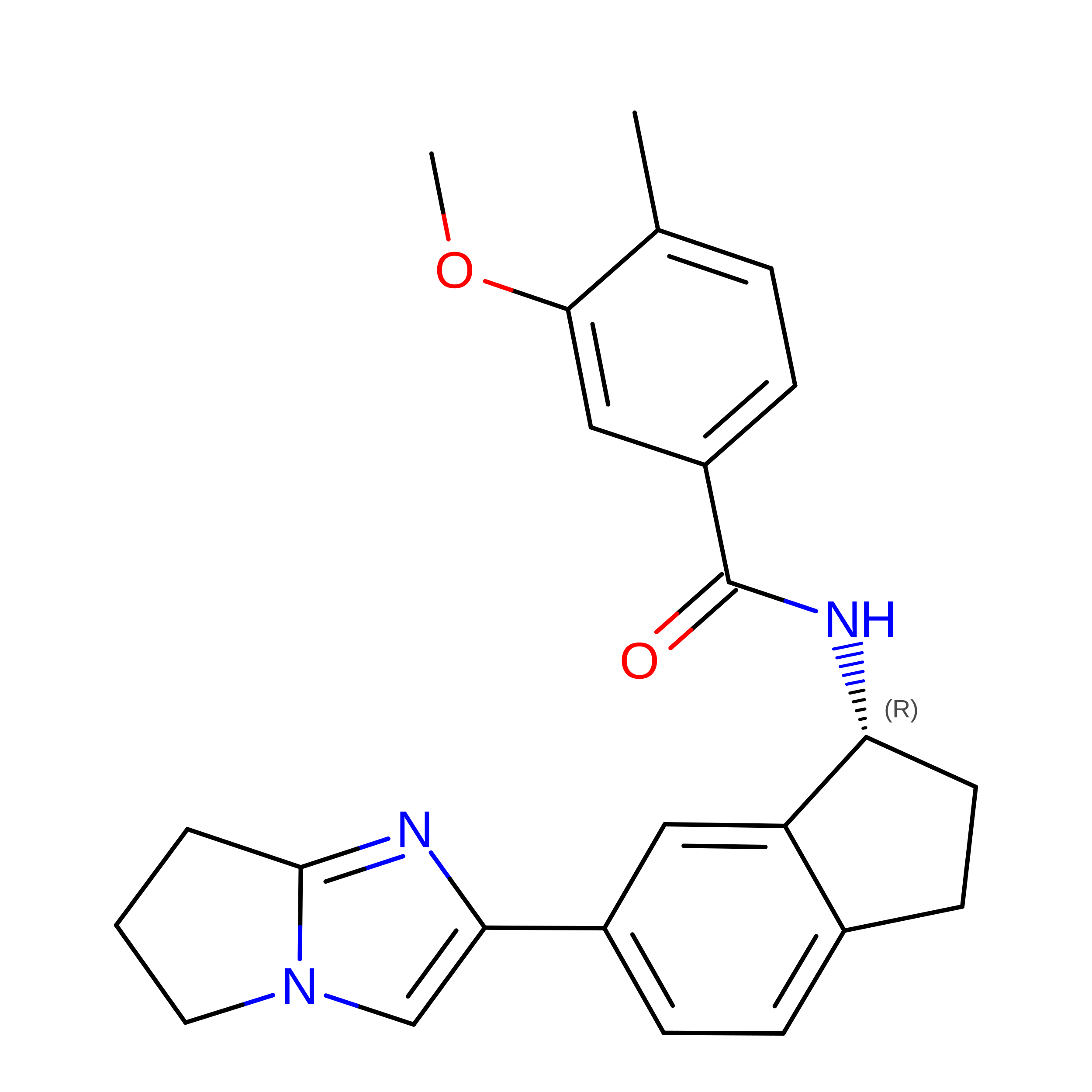
N-[(1R)-6-(6,7-dihydro-5H-pyrrolo[1,2-a]imidazol-2-yl)-2,3-dihydro-1H-inden-1-yl]-3-methoxy-4-methylbenzamide
C24 H25 N3 O2
PHINNLAJTUGZSZ-HXUWFJFHSA-N

Experimental Data & Validation

Experimental Data

  • Method: X-RAY DIFFRACTION
  • Resolution: 1.80 Å
  • R-Value Free:  0.222 (Depositor), 0.220 (DCC) 
  • R-Value Work:  0.177 (Depositor), 0.178 (DCC) 
  • R-Value Observed: 0.179 (Depositor) 
Space Group: P 1
Unit Cell:
Length ( Å )Angle ( ˚ )
a = 46.662α = 71.85
b = 53.709β = 89.86
c = 65.352γ = 73.82
Software Package:
Software NamePurpose
PHENIXrefinement
HKL-2000data reduction
HKL-2000data scaling
PHASERphasing

Structure Validation

View Full Validation Report


Ligand Structure Quality Assessment 


Entry History 

& Funding Information

Deposition Data


Funding OrganizationLocationGrant Number
National Institutes of Health/National Human Genome Research Institute (NIH/NHGRI)United StatesWDR5-MLL1 NExT Leidos Biomedical Research 16X117 HHSN2162008000 01E UNIV 57992

Revision History  (Full details and data files)

  • Version 1.0: 2018-07-18
    Type: Initial release
  • Version 1.1: 2019-12-18
    Changes: Author supporting evidence
  • Version 1.2: 2023-10-04
    Changes: Data collection, Database references, Refinement description